On 20 August 2025, Nicolas Guillou, a judge at the International Criminal Court in The Hague, was added to a United States sanctions list for his part in the arrest warrant against Israel’s prime minister. Within days his Visa and Mastercard cards stopped working. His Amazon, Airbnb, PayPal and Expedia accounts were closed, and so was his Booking account, a company run from Amsterdam and owned in Connecticut. Parcels were refused when the carrier was UPS. He could no longer book a hotel or a trip online. He described it as travelling thirty years back in time. His Slovenian colleague Beti Hohler, sanctioned for the same warrant, had her Apple ID and iCloud blocked, and a European bank she had been with for decades closed her account the day after.
None of this happened in America. It happened in the Netherlands, to European citizens, judges of a court that 125 states created by treaty, for doing their job. Thirteen of the Court’s judges, prosecutors and staff are now under the same sanctions, including, since August 2026, the Court’s own president. In February 2026, France’s president wrote to Washington asking for them to be lifted, for Judge Guillou and for Thierry Breton, a former European Commissioner targeted over the European Union’s own digital rules. Judge Guillou still cannot use his bank card, and no European institution has the power to give it back to him.
That is what a client state looks like from the inside. It is comfortable, it is prosperous, and one morning a decision taken somewhere else arrives before your own, and there is nothing to do but wait.
Six months later the same thing happened to all of us at once. On 28 February 2026, American and Israeli aircraft struck Iran, and within days almost nothing was moving through the Strait of Hormuz. Brent came within a whisker of 120 dollars in March, after the largest monthly rise on record. The International Energy Agency called it the largest supply disruption in the history of the global oil market. Nobody in Europe had been consulted, nobody in Europe had a vote, and European households got the bill. Four years after the gas shock of 2022, we found out a second time that we do not decide the price of our own heating.
What independence means, and what it does not
This post is about independence, which I define narrowly: no longer waiting to find out what Washington, Moscow or Beijing has decided about us this morning. Not autarky, not hostility, not walls. The simple capacity to say no, and to have that no mean something. The word I would use for what it restores is dignity.
Importing is not a weakness in itself. Specialisation and trade are why Europe is rich. A dependence becomes a strategic problem when four things are true at once: the good or service is essential, supply is concentrated in few hands, replacing it takes years, and someone outside has a switch, legal, technical or physical, that can turn it off. Judge Guillou’s bank card ticks all four. So does the gas that heated Germany in 2021. So does the operating system on nearly every European desk.
| Dependence | Essential | Concentrated | Slow to replace | Switch held outside |
|---|---|---|---|---|
| Gas, 2021 | Yes | Yes | Yes | Yes |
| Oil, 2026 | Yes | Partly | Yes | Yes |
| Cloud infrastructure | Yes | Yes | Yes | Yes |
| Office software and operating systems | Yes | Yes | Partly | Yes |
| Card payments | Yes | Yes | Yes | Yes |
| Weapon systems | Yes | Partly | Yes | Partly |
| Advanced chips | Yes | Yes | Yes | Partly |
That gives a test that is stricter than a slogan and far looser than self-sufficiency: for every essential service, no decision taken by a single foreign jurisdiction should be able to interrupt it without a European way of continuing within a defined delay. The rest of this post is about where we fail that test, and what it would take to pass it.
The bill of a client state
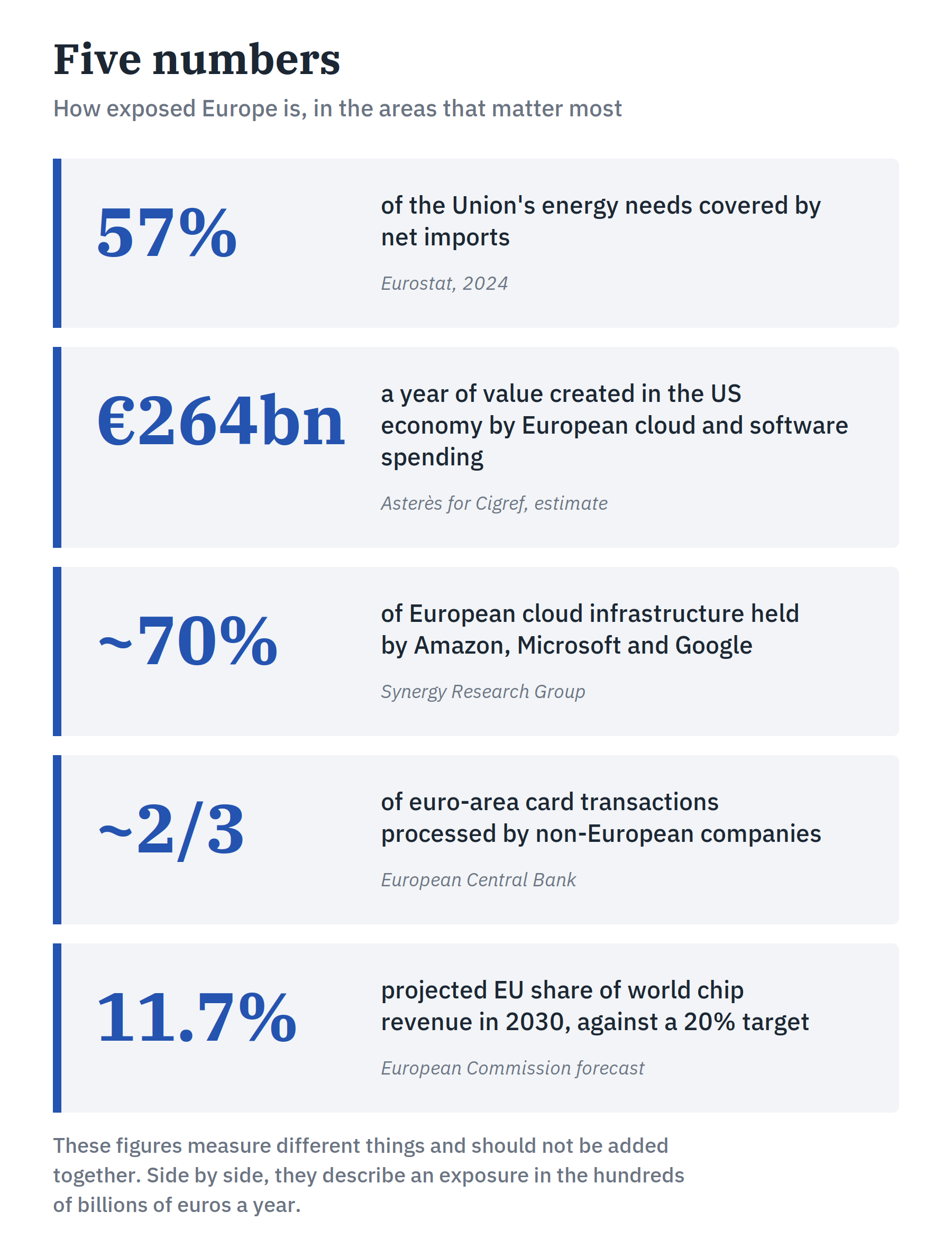
Energy. In 2024, net imports covered 57% of the Union’s energy needs, and we imported 376 billion euros of energy products. The first lesson came from Moscow. In 2021, Russia supplied about 45% of the gas Europe imported, and Germany had built its industrial model on it. When Russia invaded Ukraine in February 2022 and then throttled the pipelines, the wholesale gas price rose more than tenfold at its peak in August 2022, factories shut, governments spent hundreds of billions shielding households, and the continent spent a year scrambling for liquefied gas from anywhere it could be found. Between 2021 and 2024 Europe’s fossil fuel imports cost 1,800 billion euros; Ember estimates that the same volumes would have cost 930 billion less at pre-crisis prices. Russia still supplied close to a fifth of the Union’s gas imports in 2024, because several member states never stopped buying. Norway is now the largest supplier, and the United States provides almost half of our liquefied gas and has already used that position in trade talks. We have diversified, genuinely. We have not become independent; the nature of the dependence has changed.
Software and cloud. There are no official statistics on this, which is itself telling. A 2025 study by Asterès, commissioned by Cigref, the association of France’s largest companies and administrations, estimates that European organisations spend about 400 billion euros a year on cloud and software, that 330 billion of it goes to American companies, and that 264 billion ends up as value created in the American economy. In cloud infrastructure specifically, Amazon, Microsoft and Google hold about 70% of the European market; European providers hold 15%, and the two largest of them, SAP and Deutsche Telekom, hold 2% each. Google handles most of our web searches. Android and iOS run practically every phone on the continent. Windows runs most of our desks and Microsoft Office writes most of our documents. According to the companies surveyed, the bill rises around 10% a year through price increases customers accept because leaving is hard, which the economist who wrote the study describes as a tax in all but name.
Defence. The Draghi report, citing an estimate by the French institute IRIS, found that between June 2022 and June 2023, 78% of member states’ defence orders went to suppliers outside the Union and 63% to the United States. That period was exceptional, dominated by emergency purchases after the invasion of Ukraine, and later work by the IISS using a broader dataset finds substantially more European procurement, around half of contract value. The more robust figure is the fragmentation: depending on how you count, European armies operate well over a hundred distinct weapon systems where the United States operates a few dozen. The Draghi report notes that European equipment is equal or better in tanks, submarines, helicopters and transport aircraft. We buy American where we do because twenty-seven small buyers cannot generate the volumes that make a European system cheap, and because the alliance’s command, communications and missile defence backbone is American by default.
Chips. The Union accounts for around 10% of world semiconductor revenue, and around 2% of the fabless design market where most new chips are conceived. No European company is among the world’s twenty largest in assembly and packaging. The 2023 Chips Act set a target of 20% of the world market by 2030; the Court of Auditors called it very unlikely to be reached and the Commission’s own forecast says 11.7%. Intel cancelled the Magdeburg plant that was supposed to be the flagship. We do hold one genuine chokepoint: the Dutch company ASML is the world’s only supplier of the extreme ultraviolet lithography machines required for the most advanced chips, and we have so far used that position mostly to comply with other people’s export rules.
Payments. The European Central Bank reports that about two-thirds of card transactions in the euro area are processed by non-European companies, and that thirteen euro-area countries depend entirely on international card schemes for payments in shops. That is why a sanctions list in Washington can empty a wallet in The Hague.
These figures are not additive: an energy import bill, a modelled estimate of value created abroad and a volume of defence orders measure different things. But put side by side, they describe an exposure in the hundreds of billions of euros a year, and above all a pattern. A rich continent, a comfortable one, and one that, in the areas that matter most, does not decide.
What dependence costs beyond money
The money is the smaller part. Dependence is a lever, and levers get pulled.
Judge Guillou’s bank card is the individual version. The institutional version came a few months earlier, when the Court’s chief prosecutor, sanctioned in February 2025, lost access to his Microsoft email account. Who pressed the button is disputed between Microsoft and the Court; the result is not. A European court was cut off from its own correspondence by a decision taken in Washington, and it has since moved its office software to openDesk, an open-source suite developed for the German public administration. In June 2025, a French senator asked Microsoft France’s director of legal affairs, under oath, whether he could guarantee that French citizens’ data stored in Europe would never be handed to American authorities without French consent. He answered: “No, I cannot guarantee that.” He was being honest. American law, the CLOUD Act in particular, allows American authorities to demand data in the possession, custody or control of a provider subject to American jurisdiction, wherever the server sits. The remarkable thing is not the answer. It is that the question had never been asked.
Ukraine’s army has fought for four years partly on a satellite network owned by one American businessman, who has publicly toyed with restricting it. Europe’s gas price in the winter of 2022 was set in Moscow. Europe’s oil price in the spring of 2026 was set by a war it did not start and could not stop.
Dependence does not require hostility. Allies have their own laws, their own voters and their own interests, and those can turn against ours without anyone becoming an enemy; with an adversary, the risk is simply more obvious. You do not need an enemy to be a client. You only need to have arranged your life so that someone else’s decisions arrive before your own.
Open source, the foundation nobody talks about
Of everything in this post, this is the part I know from the inside, and the part I think Europe most underestimates.
Software is now the layer through which everything else is controlled: the grid, the bank, the hospital, the weapons, the court’s email. And there is exactly one kind of software whose continuity does not depend on its vendor staying friendly, solvent or reasonable: software whose code anyone may read, modify, host and keep running. If an open-source vendor disappears, is sanctioned or triples its prices, someone else takes the code and carries on. If a proprietary vendor does the same, you have no bridge, only a river. Open source is to digital independence what owning the plans of a bridge is to crossing a river.
It is also, oddly, a European strength that Europe does not claim. Linux was written by a student in Helsinki and now runs most of the world’s servers, every Android phone and nearly all supercomputers. LibreOffice, Nextcloud, VLC, a great deal of the Python ecosystem and countless infrastructure projects are maintained largely by Europeans. A study for the Commission in 2021 estimated that open source already contributes between 65 and 95 billion euros a year to the Union’s economy. We are among the world’s largest producers of the commons that could free us, and among its most faithful customers of the products that bind us.
Because that is the other half of the picture: Windows, Office, Google Workspace, Gmail, the Google and Apple app stores. For companies and administrations, and for each of us individually, these are not neutral tools; they are chains. Every document saved in a proprietary format, every email hosted by an American provider, every phone that needs a Californian server to certify it is genuine, is a switch in someone else’s hand. We chose these chains one convenience at a time, and they feel light because nobody has pulled them yet. Judge Guillou found out what they weigh.
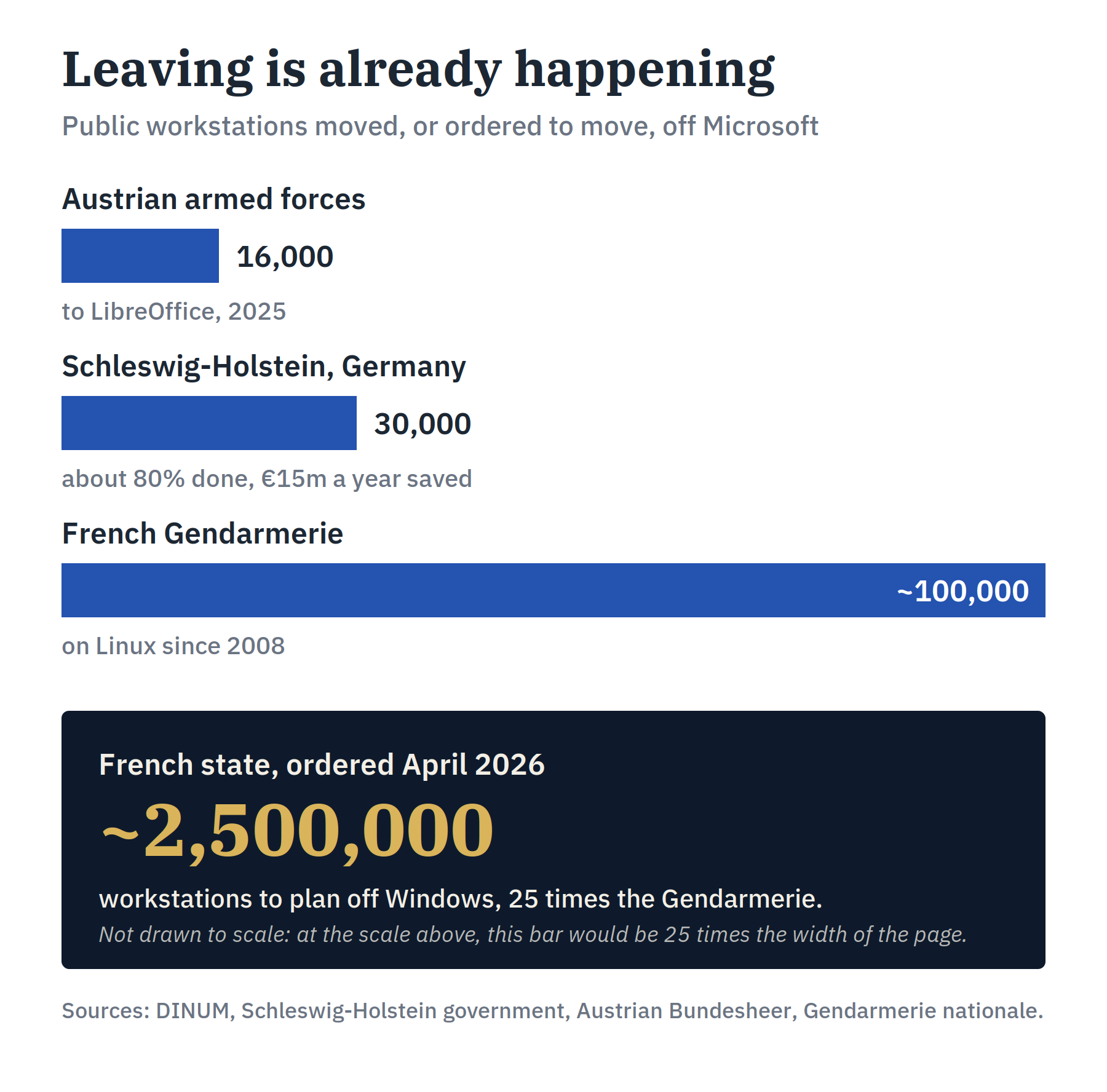
Leaving them is not utopian; it is already happening, and it works. The French Gendarmerie has run around 100,000 workstations on Linux since 2008. The German state of Schleswig-Holstein has moved about 80% of its 30,000 administrative workstations from Microsoft to open-source tools and reports 15 million euros a year in licence savings. Austria’s armed forces moved 16,000 workstations to LibreOffice in 2025. Denmark’s digital ministry did the same. The International Criminal Court moved after its email was cut. And in April 2026, France’s interministerial digital directorate ordered every ministry to plan its exit from Windows and other non-European dependencies, a scope of around 2.5 million workstations, after deciding in January that Teams and Zoom would be replaced by a French open-source tool across the civil service by 2027. I have spent the last several years building one of these alternatives myself, a version of Android without Google. It works, and so do the others.
None of this means that only open-source software is acceptable. That would be an ideology, not a policy. A European proprietary product that stores data in open formats, runs under European law and can be left without losing everything is not a chain. An open-source project whose only copy lives on an American platform is not magically independent. The criteria that matter are jurisdiction, who controls the company, whether a parent abroad keeps technical access, whether the service can run autonomously, whether you can leave with your data, whether the formats and protocols are open, and whether the code can be audited. Open source is simply the most reliable way to satisfy most of them at once, which is why it should be the default for the base layers, operating systems, office formats, identity, email, cloud orchestration, and a free choice above them.
And it starts with individuals, not only with states. You can change your operating system, your office suite, your browser, your email provider and your phone this year, without waiting for a treaty. Every European who does it makes the alternatives better and the chain lighter. It is the one part of independence that nobody has to vote for.
The proposal: what a federation could do that the current Union cannot do reliably
The Union already does some of this. The Commission proposed a Cloud and AI Development Act and a Chips Act 2.0 in June 2026, there are common defence instruments, and the European Central Bank is working on a digital euro. The problem is not the absence of ideas. It is that each of these depends on unanimity, on national budgets and on twenty-seven procurement decisions, and can be diluted or reversed at the next election somewhere. For each proposal below I name the federal power that makes it binding, and a test to know by 2040 whether it worked.
- Energy: electrify and connect. Only 23% of Europe’s final energy is electricity, a figure that has barely moved in a decade. Every electrified use can replace an imported fossil molecule with increasingly home-grown electricity, and electricity produced in Europe cannot be blockaded in a strait, provided production grows with demand. The federal power needed is authority over cross-border grid planning and a common borrowing capacity: a continental grid with interconnections sized for the whole system, a single market for storage, and the nuclear and renewable capacity planned as one fleet rather than twenty-seven. Ember estimates import dependency can be halved by 2040 through electrification. The 2040 test: net energy import dependency halved from 57%.
- Public digital infrastructure: open and European by default. From 2030, no public administration, hospital, school or court may depend, for an essential service, on software or infrastructure that fails the criteria above, and open-source stacks become the default for operating systems, office formats, email, identity and cloud orchestration in the public sector. Not a ban on anyone, a condition for public money. The Commission’s proposed act moves this way for the most critical cases; the federal power needed is a binding procurement standard applied uniformly, so that no administration can quietly renew a contract that recreates the dependence. The public sector is a large enough customer to make European and open-source providers viable, exactly as the American federal government made American ones viable. The 2040 test: no essential public service can be switched off by a single foreign decision.
- Defence: one buyer instead of twenty-seven. A federal procurement authority, as Draghi proposed, that aggregates demand, sets a minimum European content rising over a decade, and reduces each major category, tanks, artillery, air defence, combat aircraft, frigates, drones, munitions, to two or three European families. Bruegel estimates that for some high-volume items, economies of scale could cut unit costs by half or more. The federal power needed is a single buyer with a common budget. The 2040 test: a clear majority of procurement value in European systems, and the number of families per category counted in single digits.
- Chips: stop chasing 20%, hold the chokepoints. Europe will not out-build Taiwan in leading-edge fabs by 2030. It can distinguish three things and pursue each deliberately: negotiating leverage, where ASML’s monopoly on EUV lithography is a real card to be played for Europe’s reasons; industrial resilience, in the mature nodes, power electronics and packaging that cars, grids and weapons actually run on, where Europe is strong in the first two and absent in the third; and substitution capacity, through strategic stockpiles for crises. The federal power needed is a single voice in external negotiation and a common industrial budget. The 2040 test: for every chip category critical to energy, defence and health, a European or allied source able to cover months of disruption.
- Payments and access: a right to continuity. Every essential service, banking, identity, health, transport, must offer at least one way of using it that requires no account, app store or operating system controlled by a foreign gatekeeper. And a European payment network, whether the banks’ own Wero or a digital euro, that keeps working when international card schemes stop. It only protects against extraterritorial sanctions if it has no American legal connection that would trigger the same over-compliance, which is a design requirement, not a detail. The federal power needed is a right enforceable everywhere in the federation. The 2040 test: a sanctioned European judge can still pay for a train ticket.
Who pays
This proposal needs less new money than any other in the series, but it is not free, and the honest way to count it is in three layers.
First, existing demand. We already buy energy, cloud, software, weapons and payment services. Much of the programme consists of redirecting that demand, not creating new spending. Redirected spending still consumes resources, but it builds capacity on this side of the ocean instead of the other.
Second, the transition premium. European and open-source alternatives are sometimes behind, migrations cost money, systems have to run in parallel for a while, and the capital projects, grid, interconnectors, compute, defence consolidation, have to be financed. That is where common borrowing belongs, as NextGenerationEU showed in 2020, and it should be budgeted explicitly rather than hidden. Software is the cheapest part: Schleswig-Holstein is spending a one-time 9 million euros to complete a migration that saves it 15 million a year.
Third, future savings and reduced risk. The 930 billion euros Europe overpaid for fossil fuels in the crisis years illustrates what exposure to shocks costs. It does not prove, by itself, that an electrification programme would have cost less, and I will not pretend it does. It proves that the risk has a price, and that we have already paid it once.
The rule that keeps the bill honest is the one set out at the start: autonomy only where a dependence crosses the threshold of being essential, concentrated, slow to replace and switchable from outside. Duplicating every supply chain would be waste. What we stop doing is buying the switchable ones by default, subsidising twenty-seven versions of the same weapon, and treating the energy bill as weather. If the arithmetic fails anywhere, it is on the timeline, not the money. Independence is not expensive. It is slow.
The honest downsides
They are real, and several of them are arguments I have lost before.
- It costs more at first. Buying European or open source sometimes means paying more for less for a period of years. The American federal government did exactly this to build its own technology industry; it is how you get an industry. But it is a real transfer from taxpayers to an infant sector, and it should be time-limited and measured.
- Migrations can fail. Munich moved its administration to Linux in the 2000s and moved back to Windows a decade later, for reasons that were as much political as technical. The lesson from the Gendarmerie and Schleswig-Holstein is that the cost is not in licences but in training, support and the specialised software nobody thought about. Phased migration with sustained political will works; big-bang announcements do not.
- Retaliation. Washington will read “European by default” as protectionism, because it partly is, and may answer with tariffs or export controls, including on the chips Europe cannot yet make. This is a negotiation, not a war, and Europe is a market of 450 million customers; but pretending there is no cost would be dishonest.
- Sovereignty theatre. The largest American providers now sell “sovereign cloud” offers run by European subsidiaries. Whether such a subsidiary escapes the CLOUD Act depends on how much control and technical access the parent keeps, and analysts are sceptical. Europe has also produced its own theatre, projects announced with flags and abandoned quietly. The rule must be about legal jurisdiction, control and open standards, not about logos.
- National champions instead of European ones. The instinct of every capital will be to protect its own provider, its own shipyard, its own tank. Airbus took thirty years and several near-deaths to become one company. A federation that reproduces twenty-seven protectionisms has gained nothing.
- Energy independence means an energy fight. Halving imports requires both renewables and nuclear at scale, and a grid people accept in their landscape. Europe has spent twenty years refusing to choose. Independence requires choosing.
- Independence is not autarky. Europe should keep importing from friends, and should keep being a place where American and Asian companies want to sell. The goal is that no single decision taken elsewhere can switch off a hospital, a bank, a court or a winter. That is a much lower bar than self-sufficiency, and it is still a bar we do not clear today.
Why this is the emotional core of the series
The first post argued that very few people want Europe, and that the two proposals with a chance of changing that are the inheritance and this one. The inheritance is the promise. This is the pride.
People across the Union feel the humiliation already, without the numbers. They felt it when the gas bill doubled on a decision taken in Moscow, when the petrol price jumped on a war in the Gulf, when a tariff was announced on television and their government’s reaction was to hope. That anger exists, and much of it currently feeds movements that want to leave Europe, which is the one response that would make each country smaller and more dependent still. The federal answer is to give it a positive outlet: not to be left alone by the world, which is impossible, but to meet the world as an equal.
You cannot build a federation people want if the federation itself asks permission. The first test of the Europe I am describing is not a treaty article. It is the day a European judge, a European bank, a European hospital and a European household can each say no, and have it hold.
Sources and method
The figures above come from the sources below. Where a figure is an estimate or a model rather than an official statistic, the text says so.
- ICC sanctions and Judges Guillou and Hohler: heise, Justice Info, ASIL, and on the French president’s letter, L’essentiel / AFP.
- Hormuz and oil markets: IEA, Oil Market Report, March 2026.
- Energy dependency and imports: Eurostat, Energy in Europe 2026; crisis costs: Ember, Shockproof.
- Cloud and software: Asterès for Cigref; cloud market shares: Synergy Research Group; Microsoft’s testimony: The Register.
- Defence procurement: the Draghi report as summarised by the European Commission; the IISS reassessment of European procurement since 2022; Bruegel on rearmament.
- Semiconductors: European Commission, Chips Act 2.0; the European Court of Auditors special report on the Chips Act (2025).
- Payments: European Central Bank, speeches and reports on card-scheme dependence (2026).
- Open-source migrations: France’s DINUM plan, Schleswig-Holstein, the ICC’s move to openDesk.

This post is part of “A quest called Europa”, a series on what a European federation could actually change in the life of the people living in it. It starts here: Europe isn’t broken. Few want it, yet. Previous post: An inheritance for everyone, paid for by inheritance. Next post: Built to connect, built to protect. A sign-up form for the next ones is available on the series page.
Also available in French and German.
Gaël Duval, September 2026. Creator of Mandrake Linux and /e/OS, CEO of Murena. I believe Europe’s nations no longer carry any weight on their own, and that a federal Europe is the only way not just to keep them from disappearing, but to give their people something immense to hope for again. That is why I write this.
This series is written with the help of AI tools for research, structure and drafting. The ideas, the choices and the mistakes are mine.
I find the proposal quite interesting.
Regarding electricity production, how would that work? Because the main production system, in Western Europe at least, is nuclear energy. But to produce nuclear energy, you need uranium, and uranium comes from countries outside of the European union (Kazakhstan, Canada and Namibia are the top 3 producers in the World according to wikipedia).
Any of these countries could go US on Europe and stop selling uranium, which means we would not have the nuclear fuel needed to produce electricity…
(Renewable is very promising but it only works when there is wind, light or current).
Thanks for these articles!